The camel has long been known as “the ship of the desert,” but it now competes in million-dollar races without modifications. Equine expert Margreet Voermans investigates how nutrition and training regimes could transform camel racing.
World Camel Sports is dedicated to making camel racing an international sport with potential for the Olympics. Human athletes like Usain Bolt rely on cutting-edge sports medicine to achieve their remarkable feats, including being the fastest on earth. Yet, without the best shoes, nutrition, and training programs, he probably would still be running on the beach in Jamaica, not The Track King. If we expect our camels to win highly competitive races, shouldn’t we provide them with the same level of care and training that elite athletes receive? Like a high-performance car entering the Paris-Dakar rally, which required the best fuel, top-notch tyres, and skilled mechanics to tackle the most challenging terrains, our dromedary friends need their version of a pit crew.
The camel is the original all-terrain mode of transport used by Bedouins long before oil was discovered or roads were made. It is such a resilient creature; it doesn’t overheat in the desert like a car, can go days without water, and still looks majestic while doing so. “What animal brings you that far, a SUV vehicle does nowadays”, stated Safwan Modir, owner of the camel race team Al Haboob and Red Sea Camel Company. Besides being a camel breeder and film producer of Camel Quest on Netflix. “I believe SUV vehicles are evolutions of camels.” With their long legs and swaying gait, camels seem to say, Why rush? We have all the time in the world. With their long, thin legs, broad feet and powerful muscles, the Bactrian camel can carry more than 200 kg for 50 km in a day, while the more lightly built dromedaries carry up to 100 kg and still look like they just stepped out of a fashion show for Desert Chic. And don’t forget the extra accessories this transportation device comes with: built-in storage (humps full of fat energy), a GPS for navigating sand like a pro, and a personality that can go from grumpy to goofy in a heartbeat.
The close partnership between the camels and the Bedouins suggests they inherited their virtues from the original desert warrior. Affection, rather than dependence, is the foundation of this relationship.
With the discovery of oil in the Arabian Peninsula in the 1930s, the camel lost its title as a Bedouin enabler of life. Camels and Bedouins had forged an ancestral alliance that lasted thousands of years. In recent years, herds in the desert have suffered from illness and neglect, resulting in a significant decline in the region’s camel population. A passion for traditional camel races has been reignited to save the camel from extinction. Before the 1950s, races only offered small prizes, such as articles of clothing. Then, in the 1970s, the sport received official government backing to support camel owners as an incentive to grow the sport.
But evolution doesn’t stop there. As camel racing gained popularity, commercial camel racing has evolved into a thriving industry with an international audience and substantial investments. The traditional camel world was entered by famous international stars, including Netflix producers of Camel Quest, Safwan Modir and Omar Almaeena, with the racing team Al Haboob, as well as Grammy Award-winning hip-hop producer Swizz Beatz and his racing team, Saudi Bronx. The concept of racing as a team rather than as an individual is a new approach. “The strong changes and fast development in Saudi Arabia, with the Crown Prince Mohammed bin Salman, make it easier for traditional craft in the camel industry to accept these changes”, Omar said, the business partner of Safwan. “Creating a team is the best structure to compete with race camels. Camels can get injured, or we can have a bad season. However, adopting a similar approach to Formula 1 teams, with sponsorship, investments, and media, will help us overcome these situations more easily. We bring new blood into the sport and create communities of people outside the camel world watching camel races.”
From a desert ship to a racing superstar, the camel adapts to its ever-changing landscape. Camel racing developed from a nomadic tradition; how can we ensure these animals compete at the highest level? Comparing parallels between camel racing and human athletes is useful. For example, the Raramuri people of Mexico and Indigenous women running ultra-marathons using homemade sandals fueled up on traditional corn ‘pinole’. They can navigate rough terrain for hours with their skills and adaptability. Now imagine Usain Bolt, the fastest man in the world, sprinting with his state-of-the-art shoes, a super-balanced commercial diet, and a team of personal trainers, physiotherapists, and sports medicine specialists.
Bolt is an example of modern athleticism; the Raramuri, on the other hand, embody a raw and natural approach to running that helped them survive in their mountainous terrain. However, both groups show the importance of preparation, training, nutrition, and proper care, with different goals. The goal of camel racing has shifted from a traditional run to a commercial event, necessitating the need to support the camel athlete. By improving health and performance, we can enhance their racing capabilities, protect the investments made by breeding programs, and attract a broader international audience due to a more competitive sport with global investors.
Traditionally, camel training programs are not as well-established as those for horse racing. Horses are built for speed and quick bursts of energy. Their peak performance is susceptible to overuse injuries. Camels are endurance champions, designed to survive in harsh desert conditions with their long legs, unique foot structure, large lung capacity, absence of splenic contraction during exercise and skeletal muscle fibres for endurance. These differences in anatomy and physiology require a distinct approach to training. Developing customised training regimes will prepare camels for rigorous racing competitions, as with physical conditioning, the body adapts to exercise and increases performance. The body processes involved in this adaptation include cardiovascular, respiratory, skeletal, and muscular.
Parameters for each specific system should be measured during the training process. That way, a training protocol (including distance and speed) for different ages and stages can be established. Training doesn’t stop at the time of the race; recovery and rehabilitation are essential to keeping the camels fit for the next race or season and preventing injuries.
The diet is also critical in the physical training program. Camels are herbivores and initially search the desert for food sources, such as plants and other vegetation. They have a three-chamber ruminant stomach, regurgitate their food and can drink up to 100 litres of water due to the so-called ‘water sacs’ in the stomach, which, ironically, were used in ancient times to smuggle drugs into metal containers. Bedouins gave the camels fodder, such as barley, during long desert treks and dates for quick sugar access. Functional as the Raramuri people found pinole, or remarkable corn tortillas, to be a slow-starch-releasing food source, providing nutrition to help them survive. But is it also functional and optimal for racing? Scientific research on the diet of the camel is limited, and unquestioningly increasing barley or dairy leads to veterinary issues in the gastrointestinal tract of the camel. Besides, unlike a person vocal about a stomach upset, the camel can’t communicate and shows clinical symptoms at a very late stage due to its tough character.
Traditional treatments and medicine are still used to treat camels. Burning injuries are sometimes used as a counter-irritation therapy to cure the animal. For an optimally performing race camel, camel owners must be convinced to seek professional veterinary care and establish preventive health checks. Easy access to state-of-the-art veterinary hospitals should be available to protect the camel’s welfare and ensure a healthy, exciting race sport with an international audience and investments.
This is combined with an international anti-doping regulation that lists prohibited substances and procedures, such as burning. Camels with positive blood results on substances or, for example, burning scars, will be excluded, like in the equine industry. There is a doping check for substances, and the robot jockeys are screened by radiographic monitoring for electric devices, which can stimulate the camel to run even faster, but transparent worldwide regulations are lacking.
The World Camel Sports (WCS) is already working on these welfare and anti-doping measures to establish a recognised Olympic sport. “Camel racing is not a sport solely for Saudi Arabia or the Middle East, but a worldwide sport, with Olympic potential.” Prince Fahad Bin Jawali Alsaud, the president of the Saudi Olympic & Paralympic Committee and president of WCS, said during the general assembly in Greece in 2024. Yearly assemblies of all national federations are organised, and recently, in Olympia, the historic city of the Olympic Games, where even the former room of Usain Bolt was used by the participants. How close can we get to bringing the attention of camel racing to the Olympic audience? Standardisation of rules and regulations will help legitimise the sport globally.
With improved performance and clean, competitive racing, the sport will attract a larger international audience to follow the thrilling races. Pharmaceutical companies may see the potential in funding research and development for camel-registered products, which could lead to regenerative therapies that counter doping and harmful competition. Live-streamed events, social media content, and interactive gaming platforms, such as Al Hejin, can bring racing to fans worldwide, much like other sports have expanded globally.
Integrating sports medicine into camel racing is a trend and a necessary evolution that promises to enhance performance, protect valuable bloodlines, and attract a broader audience and investors.
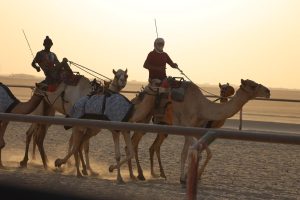
Camel race training in Al Hofuf, Saudi Arabia. Photo by MARGREET VOERMANS
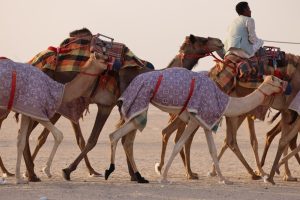
Camel race training in Al Hofuf, Saudi Arabia. Note the foot protection and socks. Photo by MARGREET VOERMANS
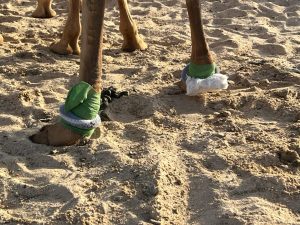
Foot protection and socks in training race camels. Photo by MARGREET VOERMANS
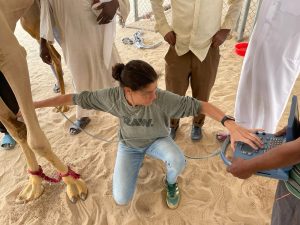
Ultrasound of injured tendon- sports medicine by Dr. Margreet Voermans. Photo by RASHEED.
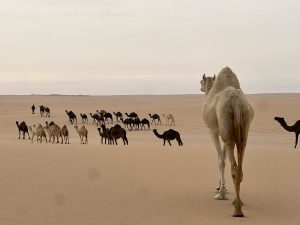
Camels from a Bedouin family walking out in the desert to find forage. Photo by MARGREET VOERMANS
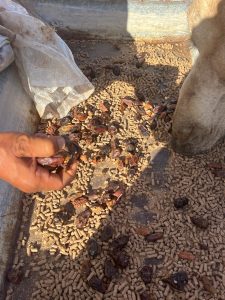
Camels in Oman are being fed traditional food, which includes concentrates with dates. Photo by MARGREET VOERMANS
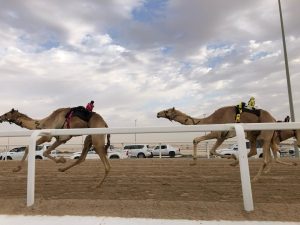
Camel racing with robot jockeys in Qatar. Photo by MARGREET VOERMANS
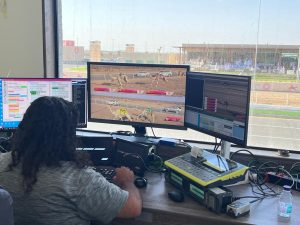
Capturing the finish during the Crown Prince camel race in Taif, Saudi Arabia. Photo by MARGREET VOERMANS
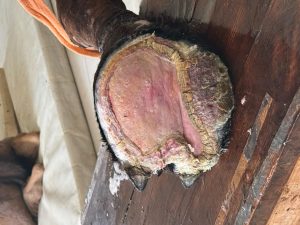
A foot injury, a common problem in camels, was admitted to King Faisal University in Saudi Arabia. Photo by MARGREET VOERMANS
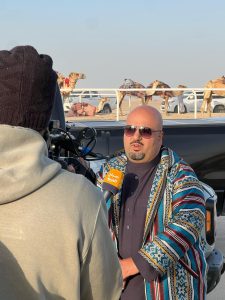
Safwan Modir is giving a television interview about sports medicine at the Al Hofuf race track in Saudi Arabia. Photo by MARGREET VOERMANS
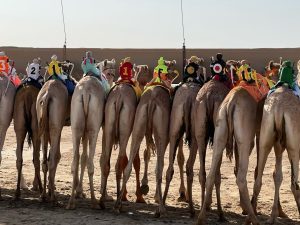
Race camels and their robots jockeys at the start line at the Al Hofuf race track in Saudi Arabia. Photo by MARGREET VOERMANS
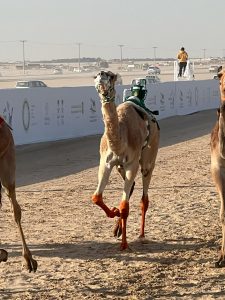
Race camel at the finish line at the Al Hofuf race track in Saudi Arabia. Photo by MARGREET VOERMANSVideo: camel race start. Video by MARGREET VOERMANS
Video: camel race finish. Video by MARGREET VOERMANS
Video: camel race preparation, robot jockeys getting assembled and put on top of the camel. Video by MARGREET VOERMANS