A decade after Rajasthan passed a law to protect its camels, veterinarians, conservationists, government officials, and camel owners came together in New Delhi this January to deliver a hard opinion: the law has failed and may be accelerating the disappearance of the camels it was designed to save.
By MARGREET VOERMANS
At the national seminar “The future of camels in India: How to ensure their conservation and well being,” held at the India Habitat Centre, more than 50 participants, including camel owners from four states, animal welfare NGOS, Food and Agriculture Organization (FAO) representatives, and Rajasthan government officials, urged immediate changes to national and state policies. Their message was clear and urgent: repeal the 2015 Rajasthan Camel Act and replace prohibition with support.
From sacred status to silent disappearance
The Rajasthan Camel (Prohibition of slaughter and regulation of temporary migration or export) Act was introduced in 2015 to restrain illegal trade and slaughter of camels, which hold deep cultural and religious significance in India. The law forbade the transport of camels outside the state, restricted their sale, and introduced prison penalties of up to five years.
But instead of reversing the camel’s decline, the law created new economic pressures that have pushed traditional herders out of the trade. Camel prices have collapsed, grazing routes have been cut off, male camels are unsellable as there is a cultural taboo and law against use of camel meat, and there is no culture of drinking camel milk.
“Camels were the way of transportation, but did lose this function in the 80’-90’.”
India’s camel population has dropped from nearly one million in the 1960s to just over 200000 today. “Camels were the way of transportation, but did lose this function in the 80’-90’.” Dr. Ilse Köhler-Rollefson, a German veterinarian, camel dairy owner and author, living in India, explained. “Around 2000, there came huge health issues and lack of grazing areas on top.”
According to the figures, the steepest declines have occurred since the law came into effect. In contrast, camel numbers in parts of the Middle East, Central Asia, and northern Africa have grown, thanks to state support and economic models.
“Our pride was to raise camels, and now we can not even feed them.” A local Indian camel owner said. He moved to Saudi Arabia to work as an employee with racing camels.
Their strength, according to Dr. Ilse Köhler-Rollefson, is a unique and caring camel culture and a herding system based on biodiverse desert trees and shrubs. “We learned camels can not be kept in confinement”, Ilse concluded. Furthermore, camel milk could address major public health issues. “We have to popularise camel milk.”
“We have to popularise camel milk.”
Seminar spotlights a broken policy
The January 2025 seminar, co-organised by Lokhit Pashu-Palak Sansthan (LPPS) and Bharat Krishak Samaj (BKS), was the first major multi-stakeholder conference on camel welfare in a decade. The event’s findings were unequivocal.
The key recommendations were:
Repeal the 2015 Rajasthan Camel Act, allowing regulated trade and movement
Support camel owners, especially young ones, with training, financial support and market access
Protect grazing areas and establish a “pastoral cell” within the Rajasthan government.
Promote camel milk as a high value, nutritious, healthy food, nationally and internationally.
The FAO of the United Nations, which participated in the event, emphasised the global importance of camels in the current climate change, food security and rural resilience. India risks becoming an outsider if policies continue to be set against the camel owners.
Ethics and economy in conflict
The law has also raised ethical and socioeconomic concerns. Because long-standing trade routes and slaughter practices are forbidden, it affects communities that have traditionally depended on camels for their livelihood. Many camel traders have faced increased restrictions and legal issues. The law puts the responsibility on camel owners to prove they are not breaking the rules, instead of requiring authorities to prove that they are. This rule is considered unfair and unusual in a legal system by many people. These problems have made life harder for communities that have traditionally raised and cared for camels, and they feel left out and financially insecure.
A global camel future without India?
Other countries are taking very different approaches to camel conservation. In Saudi Arabia, camels are treated as important cultural symbols and receive support. For example, at King Faisal University, camel owners do not have to pay for their visits and treatments, the government is paying. In Mongolia, camel herding is officially recognised as part of the national cultural heritage. In some African countries, camels are promoted as valuable livestock that can survive the tough climates. In contrast, India’s efforts to protect camels have focused on restrictions and punishment, rather than supporting people who raise them. Without better policies that include camel owners, India risks falling behind in global efforts to preserve and sustain camel culture.
Next steps: from policy to preservation
The seminar closed with a conclusion for immediate policy reform, economic investment, and international collaboration. Some participants, including Dr. Ilse Köhler-Rollefson, suggested submitting India’s camel culture for UNESCO heritage status to unlock global support and attention.
Whether the Rajasthan government will act remains uncertain. But time is running out for camel owners.
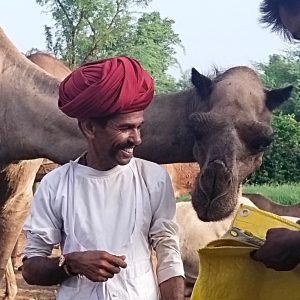
Camel and herder in Rajasthan. Photo by Ilse Köhler-Rollefson
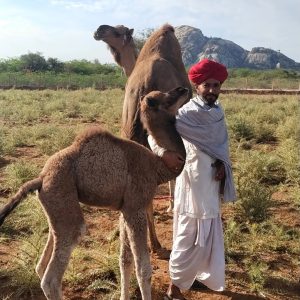
Camel and herder in Rajasthan. Photo by Ilse Köhler-Rollefson
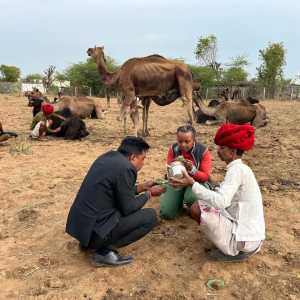
Camels, herders and visitors sharing camel milk in Rajasthan. Photo by Ilse Köhler-Rollefson