In a country renowned for restricting women, change is afoot following the successful graduation of the first female veterinary graduates. Margreet Voermans investigates whether success is a matter of mindset in this male-dominated profession with a problematic work-life balance.
By MARGREET VOERMANS
In 1903, Mignon Nicholson was the first woman to receive a doctorate in veterinary medicine. More than 100 years later, the first female Saudi veterinarians are breaking down barriers as they prepare to graduate from Saudi Arabia’s first veterinary degree program for women.
“Just months before going to university, they announced the opening of the first Saudi female veterinary track at King Faisal University. Immediately subscribed to follow my childhood dreams,” says Fatimah Tawfiq, one of the first female veterinarians who graduated from King Faisal University in Saudi Arabia. Explaining her and her fellow students’ motivation to enrol in veterinary medicine at the same time.
The new course began in 2018, coinciding with Saudi women being allowed to drive cars and enter sports stadiums. That same year, female entrepreneurs could finally start a business or obtain a passport to travel abroad without their husbands’ permission.
Time will tell whether the country, future husbands, animal owners, and the wider society are finally ready to embrace women as professionals and entrepreneurs. Yet the challenge of studying veterinary medicine is just the start of a new era.
“We need to tell our mothers to pick the right husband to be able to work after graduation,” Latifa Alhussaini, a last-year veterinary student at King Faisal University, said confidentially about her future. A well-educated progressive girl, overthinking her future.
“I have never worked with a veterinarian before applying to veterinary medicine. I did watch YouTube videos of veterinarians,” admits Fatimah. She grew up in the city where the university is based. Her family didn’t have farm animals but did have some pets.
“A few months before leaving high school, the university announced the opening of the first veterinary curriculum for females in 2019. There were some basic prerequisites regarding grades, but no specific topics, and the Government paid for our studies.”
Fatimah revealed that out of the “80 women who started that first year in 2018, half quit after the first year as they didn’t understand what veterinary medicine was about.”
Classes still separated men and women in those early years. Despite the enforced student segregation, the professors were exclusively male. This initially created an uncomfortable situation for students and teachers, mainly because there was no physical barrier between them during classes, such as a glass wall. The girls were always accompanied during oral examinations so that they wouldn’t sit alone with a male professor.
However, times are changing, in the past five years, there have also been mixed classes, with both males and females. Yet, while observing last year’s students, I was surprised to see that male and female students always stood separately, even in the same class.
According to Latifa, who is from a very open-minded medical family without restrictions, this is because they feel more secure and understood by other females. They grew up separated and felt empowered by other women. At first sight, it seems abnormal to me to be so separated. However, in the end, we think it may be the same, but we hide it.
The first veterinary chair, Dr. Shinkawa of the National Association of Women Business Owners (USA), mentioned that female-run businesses differ from male ones.
“In female-led companies, a lot of listening happens. We’re not dictating and telling, but we’re listening and earning trust, and you can make hard decisions because you’ve built that groundwork. We’re typically more patient to get where we want to go.”
Are these female Saudi students not ahead of Western students in being prepared for business owners in the current society?
None of the students asked questions to the professor in public, so as not to offend the professor, doubting their knowledge, continued Latifa. At first sight, it appears to be a much more hierarchical relationship between professor and student. However, the morning greeting showed the opposite, as male students hugged and kissed the professor. Of course, the females don’t; there is always physical distance.
When preparing for scrubbing in for surgery and putting on the sterile jackets, women always help their female counterparts. These habits stem from showing respect to one another, and they do not view this as a challenge during their education or life. It might prevent “Me Too” situations.
Surprisingly, the only difference Fatimah encountered while spending her summer holiday in a German Equine vet Hospital between her and the European female vets was physical strength. “They can push a cow by themselves.” Of course, Saudi females didn’t grow up with public sports, as it was only allowed recently.
Talking about their vision of the future, Latifa thought it all over. “You have to pick the correct husband”, explained Latifa. However, they overthink this issue way more. The mother of the future husband will still choose her son’s wife. But as Latifa wants to be a working wife, she will make it clear that she wants a husband who accepts a working wife. It is not an issue of money to start working as a woman, as her salary is deposited entirely into her account by law in Saudi Arabia. The man’s wages must be shared with his wife and children. As the woman only works out of her desire to do so, she might be able to put way better boundaries.
“I will separate my career and private life. Not working after hours or weekends. Therefore, I didn’t want to become a farmer. A farmer is a way of life.” Latifa said.
In Western countries, the burnout percentage among veterinarians is very high, reaching 70- 75% according to a recent research in Frontier veterinary Science, as well as the suicide rate. The primary risks include high work pressure, a lack of work-life balance, low salaries, and extended duty hours. In Western countries, veterinary practices with several veterinarians or referral hospitals are standard.
However, in Saudi Arabia, they appear sporadic. This is problematic because vets need to work out of hours to ensure cover is provided.
Latifa has a clear vision for her future, stating that she would “love to be the first female veterinary professor in Saudi Arabia.” Her high grades and a supportive family background are a good indication of her ability to achieve this. However, this is unlikely to be true for most future female veterinarians in Saudi Arabia.
Due to Saudi Arabia’s Vision 2030, the pay gap, maternity leave, and female business owners are well-regulated by law. While major cities like Jeddah and Riyadh have embraced mainly these changes, rural areas are less satisfied with the new Saudi Arabia, especially regarding women working in mixed-gender environments in general, according to Fatimah and Latifa. This fact influences female Saudi veterinarians. In Muslim countries like Saudi Arabia, having dogs as pets is still uncommon. Most dogs are for security; cats are more commonly kept as pets. As a result, most veterinarians in practice will end up in these rural areas.
In addition to this geographical location, Vision 2030 does not significantly influence the acceptance of farm animal owners towards female veterinarians. Even in Europe, these owners still prefer male veterinarians. However, 80% of European female veterinarians work with small animals in practice.
Another new aspect in the Saudi veterinary world is the growing importance of networking for women. The expectations of them staying at home after work to care for the children limit their development of social interactions, building a better network, and gaining better work positions or leadership roles. Even when conferences are organised, gender segregation continues to limit Saudi women’s access to establishing new work-related connections. During the National Saudi Federation conference, the commercial stands of pharmaceutical industries and other veterinary industry-related companies are represented by men.
Consequently, the female students were isolated and gathered around female student games or coffee places. Lacking professional networks is a general problem for female Saudi workers. These personal connections, in particular, influence their ability to secure higher positions.
Will this male-dominated society embrace change and allow female vets to treat beloved pets of families or advise the agriculture business on which path to follow?
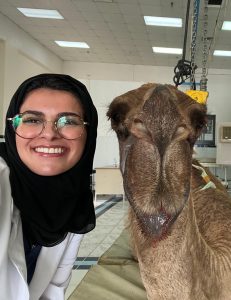
Latifa at King Faisal University with a camel for treatment. Photo by MARGREET VOERMANS
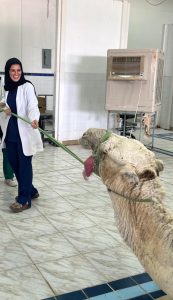
Latifa at King Faisal University with a camel for treatment. Keeping the camel in control with a rope. Photo by MARGREET VOERMANS

Fatimah at her graduation, as the first female Saudi veterinarian to graduate in Saudi Arabia. Photo by MARGREET VOERMANS
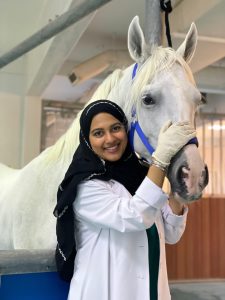
Fatimah is dealing with an injured horse. Photo by MARGREET VOERMANS
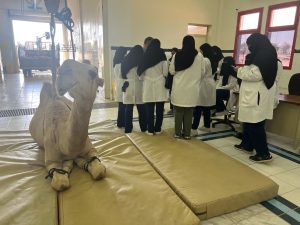
Female veterinarian students are getting practical classes at King Faisal University. Photo by MARGREET VOERMANS