In Mongolia’s Gobi Desert, young nomads fight climate change, economic shifts, and urban migration. Margreet Voermans explores how they maintain a traditional life through camels, ancestral family knowledge, and festivals like the Camel Winter Festival.
By MARGREET VOERMANS
A strong, cold wind blows over the snow-covered Gobi Desert as a small boy in sheepskins guides his camel to the festival ground. Around him, family and friends drink fermented milk, sing traditional songs, and gather together in the town ger, a traditional, portable dwelling, a nomadic house. Meanwhile, many Bactrian camels, steaming with their breath, wait for the competitions. There are no golden prizes, only pride.
This is the Winter Camel Festival, a powerful expression of the endangered nomadic life of Mongolia. In this life, the camel is not a trophy but a means of survival. The festival takes place each February in the southern province of Umnugovi beneath a cloudless sky and at temperatures below 30 degrees Celsius.
Born to survive
To outsiders, Mongolia’s nomads may appear to be the last Vikings. However, they are actual survivors who have adapted to become engineers of one of the world’s toughest ecosystems. For centuries, they have lived off the land they have conquered without damaging it. They build transportable gers as homes, which are warm enough for -40 °c winters, and herd livestock across open landscapes without fences, electricity, or running water.
The Mongols have a long prehistory. Once the nomadic tribes formed by Genghis Khan, they controlled a vast empire that included much of China, Russia, Central Asia, and the Middle East. They did conquer all this territory on horseback. This empire was not built on stone walls but on movement, memory, and muscle. Today, this legacy struggles not because of invasion but because of climate change, economic migration, and shrinking opportunities.
Climate impacts the herd
The Gobi Desert is heating and drying. Local herders call it dzuds, referring to brutal winters that follow drought, leaving frozen carcasses and an empty desert landscape. Summer rains are now unreliable, grasslands disappear, and more dunes appear.
Due to limited access to grassland, a herd transition from cows and horses to camels and goats has been necessitated. Their needs are fewer, and animals have a greater chance of survival. Goats can be used to produce cashmere, while camels can survive in climates where almost nothing else can.
“We changed our herds because the climate changed, now we focus on camels, goats and sheep,” explains Sagua Lkhagvasuren Tudev, a 29-year-old herder who grew up with his nomadic grandparents in the Gobi. Sagua studied as a bachelor of land management and cadastre at the university in Ulan Bator, speaks fluent English, and guides foreign visitors around Mongolia.
He is part of a new generation of half-nomads. They work in the city but remain deeply connected to their nomadic roots. For Sagua, desert life remains part of his identity. “I am not a city person 100%. I come back every few weeks. I still have my animals. It is part of who I am.”
A government push to save the nomads
The Mongolian government has launched innovative herding programs to prevent the migration of young nomads to Ulaanbaatar. They offer them small herds of livestock, mostly goats and sheep, interest-free for two years. This program hopes to encourage young nomads to stay and others to return to the nomadic lifestyle
“If the weather is good, a camel herd can double or triple,” says Sagua. “I have seen it work.” However, the weather nowadays is unpredictable, and failure often comes without warning. But it is still a worthwhile initiative to explore ways to return to a sustainable, land-based nomadic lifestyle.
For many young people, it is the only alternative to low-paid city jobs or life in distant mining camps.
The festival that money can’t buy
Every winter, the winter camel festival offers a rare opportunity to gather together with those from the different towns in their ger and exhibit their talents in various competitions.
There are no racing robots, giant LED screens, or millions in prize money. Instead, families arrive with their camels in traditional clothing, setting up their ger of the town, drinking fermented milk and homemade food, and celebrating their camels in competitions while singing typical Mongolian songs.
One impressive competition at this event is the 16 km adult male camel race. Young riders, boys and mostly young teenagers ride their camels up to the start line in bone-chilling temperatures. Full of dedication, the chill doesn’t seem to bother those riders.
The air is ripe with anticipation as camels hold their heads proud in the wind, and the jockeys giving all their strength and passion to the race. However, it was surprising to see myself that, despite competing, they still help each other. One camel didn’t want to race anymore, but I did see another jockey helping his friend and pulling his camel back into the race. That’s true sportsmanship.
Launched by camel breeders in the early 2000s, the festival aims to protect the Bactrian camel population, as well as to stimulate the herders to tame their male camels to be able to participate in the competitions. Today it serves as a cultural stimulus as well as an economic one. There are short and long distance racing, beauty competitions, taming competitions, camel polo, ice archery, and even music performances by local herders.
The prize? Immense pride.
“This isn’t like the Gulf,” says one organiser, who wished to remain anonymous. “We are not doing this for money, but for celebrating our culture and making memories.”
Indeed, the Middle East camel culture is very different. Camels are commercialised, glamorised, and pampered to win the race or beauty contest. Milked in air-conditioned barns and raced using robot jockeys, they also compete in beauty contests. In such contests, Botox, fillers, and surgical enhancements have become so common that specialised veterinary equipment and teams now inspect the camels for fraud.
In the Gulf, camels are a business. In Mongolia, there are bloodlines and survival tools.
This year, I was invited to speak as a camel surgeon about the importance of the welfare of the Bactrian camel. One of the first times, my complete audience consisted of female herders, dressed in their most beautiful coloured traditional clothes. We discussed the importance of preventing inbreeding, as many families own one bull and use him to breed over several years.
Inbreeding can lead to the development of genetic diseases and is a significant concern for the future of the camel. They had already seen orthopaedic malformations caused by inbreeding and were curious about solutions.
Yet progression is afoot. The government is establishing a camel research centre in the southern Gobi Desert to combine the traditional camel wisdom with veterinary research science from abroad to preserve Mongolia’s camel future.
Camel milk was also discussed as it is a traditional source of nutrition for nomads. However, due to climate change, pastures are shrinking and pushing young people toward the city, but camel milk offers a form of resilience. Bactrian camels, with their thick coats and ability to survive on sparse forage, are uniquely adapted to Mongolia’s harsh conditions.
Besides, the camel plays a crucial role as an ecosystem engineer. They have a unique grazing behaviour that maintains balanced plant communities and prevents overgrazing. They are selectively browsing on hardy desert vegetation.
Additionally, camels play a crucial role in desert plant propagation through a natural process known as endozoochory. Seeds ingested during feeding are excreted within nutrient-rich dung, which enhances seed germination and plant diversity.
Their milk requires no refrigeration when consumed fresh, no imported feed to produce it, and no plastic packaging for distribution.
But there is a hidden risk.
Raw camel milk, though cherished by camel herders, can carry zoonotic diseases such as brucellosis, which can cause diseases in humans. Without proper veterinary control or pasteurisation, this food source can become a public health concern. Especially during these festivals, foreign visitors are consuming it.
For Mongolia’s nomadic future to be truly sustainable, tradition, hygiene and veterinary care must go hand in hand.
Mongolian nomads are pioneers
A nomadic life is often misunderstood as a sign of backwardness or poverty. Their roots are brilliant. Yet nomads are pioneers, having engineered mobile homes, gers that withstand the extreme cold winters as well as the extreme heat in summer. These gers are made from natural materials, including hair from camels, animal skins, and wood. Fires are made from the faeces of camels.
“We don’t waste anything,” reveals Sague. “Everything we use is grown, traded, or made by hand. That is not poor, that is smart.”
Centuries ago, these same deserts produced the armies of Genghis Khan. Today, they still produce resilience, innovation, and sustainable knowledge that the modern world could learn from, if it looks beyond their asphalt borders. They are a proud culture, not just because they live there, but they know how to.
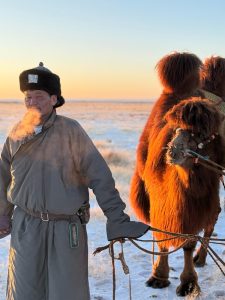
A nomadic herder holding his camel in Gobi desert. Photo by MARGREET VOERMANS
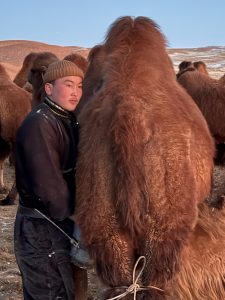
A nomadic herder milking his camel in Gobi desert. Photo by MARGREET VOERMANS
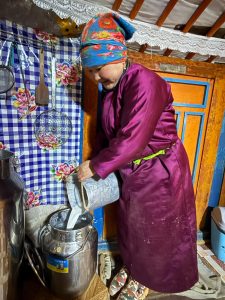
A nomadic herder brings the fresh camel milk inside the ger in Gobi desert. Photo by MARGREET VOERMANS
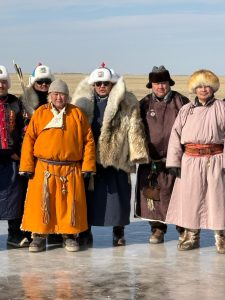
Ice archery nomadic men are ready to compete at the Camel Festival in the Gobi Desert. Photo by MARGREET VOERMANS
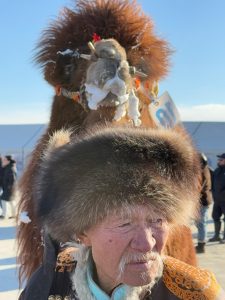
A nomadic herder holding his camel at the Camel Festival in the Gobi Desert. Photo by MARGREET VOERMANS
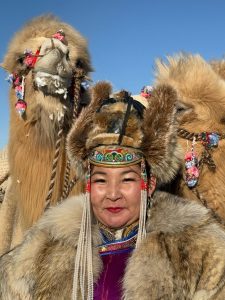
A woman competing in the beauty contest, the most beautiful couple at the Camel Festival in the Gobi Desert. Photo by MARGREET VOERMANS
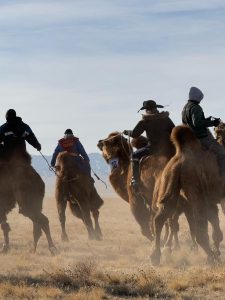
After walking to the start line, the camels take a quick turn to start the race at the Camel Festival in the Gobi Desert. Photo by MARGREET VOERMANS
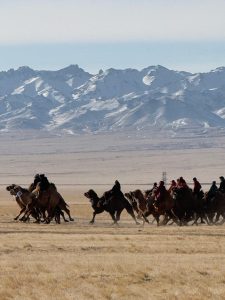
Camel race at the Camel Festival in the Gobi Desert. Photo by MARGREET VOERMANS
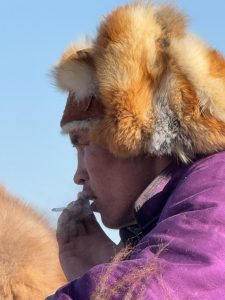
A young herder, smoking his cigarette, watches the camel race to start at the Camel Festival in the Gobi Desert. Photo by MARGREET VOERMANS
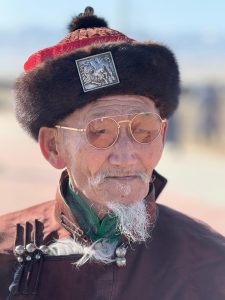
An older nomadic herder comes to attend the Camel Festival Gobi Desert. Photo by MARGREET VOERMANS
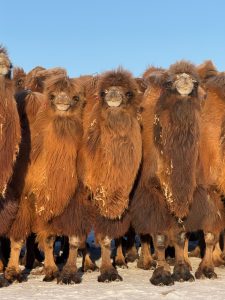
Bactrian camels at the farm of a young nomadic herder, supported by the Mongolian government. Photo by MARGREET VOERMANS
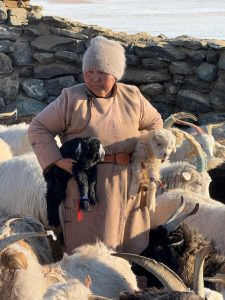
A nomadic herder taking care of the goats and their kids/ bobs. Photo by MARGREET VOERMANS
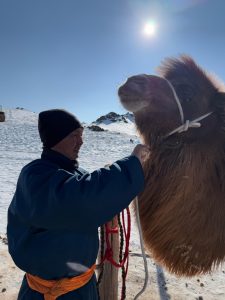
A young nomadic herder prepares his camel to go for a walk. Photo by MARGREET VOERMANS